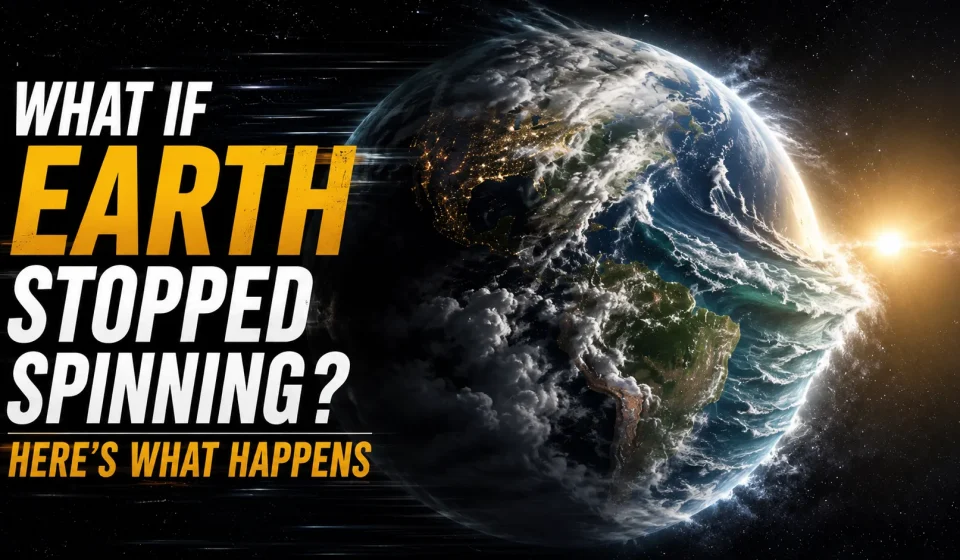

Short answer: nothing good.
Within hours, most of the planet’s surface would be wiped clean, oceans would slam into continents like a tsunami with no end, and the atmosphere itself would keep moving at over a thousand miles an hour even after the ground beneath it stopped. This isn’t science fiction. It’s basic physics, and it’s honestly more terrifying than most disaster movies bother to show.
I started digging into this after a random 2 AM YouTube rabbit hole, and what I found stuck with me for days.
The speed we don’t feel
Earth spins at roughly 1,037 miles per hour at the equator. You don’t feel it because everything around you—the air, the water, and your coffee cup—is spinning right along with you. Same reason you don’t feel like you’re moving on a plane at cruising altitude. It’s not stillness. It’s shared motion.
Now imagine someone hits the brakes. Not gradually. Instantly.
The first ten seconds
Everything not bolted to bedrock keeps moving at that original 1,037 mph, because inertia doesn’t care that the ground stopped. Buildings, trees, cars, people. All of it gets launched sideways at highway-plus-supersonic speed. This isn’t an earthquake. It’s closer to the entire surface of the planet being hit by an invisible wall.
Where I live, that would mean everything just… gone. Scraped off. I think about that a lot when people casually ask “what if” questions like this.
The oceans have their own plans
Water isn’t attached to the crust the way rock is. So while the solid ground jolts to a stop, the oceans keep sloshing at full spin speed, creating waves that make a tsunami look like a ripple in a bathtub. Entire coastlines would get erased before anyone had time to process what was happening.
Meteorologists have actually modeled a slower version of this, gradual deceleration over years instead of seconds, and even that scenario ends in permanent megastorms and mile-high waves circling the globe.
The atmosphere doesn’t stop either
Air has mass, and mass has momentum. So even after solid ground stops, the atmosphere keeps ripping across the surface at wind speeds that make Category 5 hurricanes look like a light breeze. Some estimates put post-stop wind speeds above 1,000 mph, fast enough to sandblast mountains flat over time.
What happens after the chaos settles
If, somehow, life survived that initial phase (unlikely, but let’s play it out), Earth would eventually settle into a very different rhythm. A full rotation would take exactly one year instead of 24 hours, meaning one side of the planet bakes in 6 months of continuous daylight while the other freezes through 6 months of night. The magnetic field, which is generated partly by Earth’s spin, would weaken. Without that field, we’d lose a major chunk of our protection from solar radiation.
So no, it’s not just “a really long day.” It’s closer to a full reset of everything the planet’s ecosystems, weather, and geography currently depend on.
Why this thought experiment actually matters
Questions like this aren’t just fun trivia. They’re a reminder of how much of daily life runs on physical processes we never think about. Rotation. Gravity. Momentum. All quietly doing the work that keeps oceans in place and weather patterns livable.
Next time you’re annoyed about losing an hour to daylight saving time, remember: it could always be one continuous year-long day instead.